Skip to Content
Electric eTuk L5 platform illustrating lithium-ion battery powered commercial mobility

Battery performance, charging and lifecycle

Electric Tuk Tuk Battery Life & Care

Current L5 eTuk vehicles use a lithium-ion energy configuration. Battery life is not determined by one number of years alone: charging habits, temperature, storage, route, terrain, payload, utilization and auxiliary electrical demand all influence how the energy system performs over time.

Lithium-ion energy system Standard 110V charging Typical 8–12 hour full charge Charger included

Battery configuration is selected around the vehicle and intended application. Exact battery specifications, range and replacement requirements should be confirmed for the ordered vehicle.

Direct answer

How long does an electric tuk tuk battery last?

There is no responsible single lifespan number for every eTuk battery. Battery aging depends on how frequently the vehicle operates, how it is charged, the temperatures it experiences, how it is stored, the route and terrain, vehicle load and any auxiliary electrical demand.

  1. Use the vehicle regularly within its intended operating role.
  2. Follow a consistent charging routine.
  3. Plan storage rather than leaving the vehicle unmanaged for long periods.
  4. Account for route, grade, temperature and payload.
  5. Monitor changes in usable operating time and charging behavior.

Charging

Routine Matters

Consistent charging should be part of the normal operating procedure.

Climate

Temperature Matters

Environmental conditions can affect battery performance and energy demand.

Route

Workload Matters

Terrain, stops and payload change how the vehicle uses energy.

Storage

Downtime Matters

Long-term storage should be planned rather than treated like normal daily parking.

Battery-life factors

Six things influence battery performance over time.

Battery life is the result of the vehicle, environment and operating routine working together.

01 / UTILIZATION

How Often It Works

Daily duty cycle and operating frequency influence the energy system over time.

02 / CHARGING

How It Is Recharged

Build charging into a predictable daily operating routine.

03 / CLIMATE

Where It Operates

Temperature and environmental conditions influence energy performance.

04 / TERRAIN

Where It Drives

Grades, surfaces and stop frequency affect vehicle energy demand.

05 / LOAD

What It Carries

Passenger, cargo and equipment requirements are part of energy planning.

06 / AUXILIARY POWER

What Else Uses Energy

Commercial electrical equipment should be accounted for separately in Cargo and Vendo projects.

Passenger electric eTuk illustrating daily battery charging and ownership
Normal eTuk charging uses the supplied charger and standard 110V electrical power.

Battery care begins with charging

Make charging predictable rather than reactive.

Normal eTuk charging uses a standard 110V outlet and the charging equipment supplied with the vehicle. A typical full charging cycle takes approximately 8–12 hours.

That makes overnight charging a natural pattern for many private, hospitality, campus, municipal and commercial operators.

  • Use the supplied or approved charger
  • Provide appropriate standard 110V electrical access
  • Use predictable vehicle downtime for charging
  • Protect the charging cable and connection area
  • Assign responsibility when multiple people use the vehicle
  • Monitor meaningful changes in charging or operating behavior

Energy system by application

The route should influence the energy plan.

The current L5 platform approach considers route, climate, terrain, payload and auxiliary equipment when defining vehicle energy requirements.

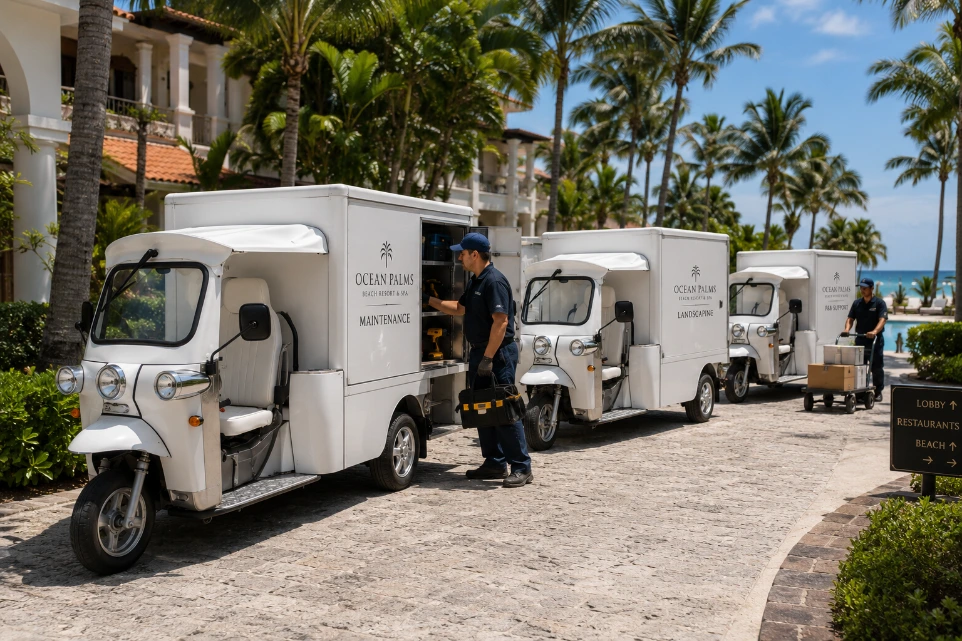
Multiple electric eTuks illustrating different vehicle duty cycles and energy requirements

Ask what the vehicle must do every day.

Passenger routes, maintenance shifts, event operations and mobile vending can create very different duty cycles even when the vehicles share the same L5 platform.

ROUTE

Distance & Stops

Repeated stops and the actual route pattern influence energy use.

TERRAIN

Grade & Surface

Hills and operating surfaces belong in vehicle planning.

LOAD

Passengers, Cargo & Equipment

What the eTuk carries is part of the required duty cycle.

What affects range?

Range is an operating result, not just a battery number.

A useful range discussion starts with the actual route rather than one universal distance claim.

ROUTE

Distance

Daily mileage and route repetition determine how much energy is required.

TERRAIN

Grade

Hills and route profile influence actual energy consumption.

WEIGHT

Payload

Passengers, cargo and installed equipment change the operating load.

ENVIRONMENT

Climate

Temperature and operating conditions can influence battery performance.

Practical battery care

Good ownership habits are mostly operational habits.

The goal is to make charging, storage and vehicle condition part of the routine.

01 / ROUTINE

Charge Consistently

Use predictable downtime rather than waiting for charging to become an operational emergency.

02 / PARKING

Use a Defined Location

Give the vehicle a repeatable parking and charging location.

03 / STORAGE

Plan Extended Downtime

If the eTuk will not be used for an extended period, follow the appropriate storage procedure rather than treating it like one normal overnight stop.

04 / LOAD

Use the Correct Vehicle

Match passenger, cargo and equipment requirements to the intended configuration.

05 / OBSERVATION

Notice Changes

Changes in usable operating time or charging behavior should become part of the service conversation.

06 / SUPPORT

Use eTuk Documentation

Service decisions should be based on the exact vehicle rather than assumptions from unrelated EVs.

Cargo & Vendo energy systems

Vehicle propulsion and commercial equipment do not have to be treated as one load.

Commercial builds should account for refrigeration, pumps, lighting, POS and other auxiliary electrical demand.

Cargo electric eTuk illustrating auxiliary power planning for commercial vehicle operations

Cargo Auxiliary Power

Appropriate Cargo projects can be evaluated with an auxiliary power unit or additional energy source when the operating requirement justifies it.

 Explore Cargo eTuk → 
Vendo electric eTuk illustrating separate commercial equipment electrical demand

Vendo Separate Circuit

A Vendo build can be designed so the commercial box or equipment operates on a separate circuit when the application requires it.

 Explore Vending eTuk → 

Battery questions before buying

Start with the route, then select the vehicle.

Tell eTuk USA how the vehicle will actually operate: route, terrain, climate, passengers or payload, daily schedule and any auxiliary equipment. That produces a better energy discussion than choosing a vehicle from a range number alone.

Responsible battery expectations

Do not reduce battery performance to one universal number.

Vehicle configuration and operating conditions matter to range and lifecycle.

RANGE

Use the Actual Route

Range should be evaluated against terrain, load and operating conditions.

LIFESPAN

Avoid Guaranteed Years

Battery aging depends on use, charging, storage and environment.

COMMERCIAL

Count Auxiliary Loads

Vendo and Cargo equipment can change the complete energy requirement.

WARRANTY

Use Current Terms

Warranty questions should be answered from the applicable vehicle documentation.

eTuk Battery FAQ

Straight answers about eTuk battery life and performance.

Battery performance makes the most sense when discussed together with the actual route.

What type of battery does the current eTuk L5 use?

The current L5 platform uses a lithium-ion energy configuration.

How long does an electric tuk tuk battery last?

Battery life does not have one universal number of years. Utilization, charging habits, climate, storage, route, terrain, payload and auxiliary electrical demand can all influence battery aging.

How long does an eTuk battery take to charge?

A typical full charging cycle takes approximately 8–12 hours.

What outlet does an eTuk use for charging?

Normal eTuk charging uses a standard 110V electrical outlet and the charging equipment supplied with the vehicle.

Is the charger included with the eTuk?

Yes. Charging equipment for normal vehicle charging is supplied with the eTuk.

What affects electric tuk tuk range?

Route distance, terrain, temperature, payload, operating pattern and auxiliary electrical demand can all affect actual energy consumption and usable range.

Does carrying more weight affect battery use?

Payload is one of the operating factors considered when planning the vehicle's energy requirements. Passenger, cargo and equipment loads should be included in the route analysis.

Can Cargo and Vendo eTuks have separate auxiliary power?

Yes. Appropriate Cargo and Vendo projects can be evaluated with auxiliary power solutions or separate electrical circuits depending on the equipment and operating requirements.

What should I do if the eTuk will be stored for a long period?

Extended storage should be treated differently from normal overnight parking. Follow the applicable storage guidance for the exact vehicle and contact eTuk USA if the vehicle will remain unused for an extended period.

Does battery charging affect total cost of ownership?

Yes. Electricity and charging are part of the overall operating-cost picture alongside acquisition, financing, maintenance and utilization.

Is battery coverage included in the eTuk warranty?

Applicable battery and vehicle warranty terms should be confirmed from the current warranty documentation for the specific eTuk.

Tell us the route. We can help define the right eTuk for the job.

Share the application, daily route, terrain, climate, passengers or payload, operating schedule and any auxiliary electrical equipment so the vehicle and energy requirements can be evaluated together.