Maintenance & Property Operations
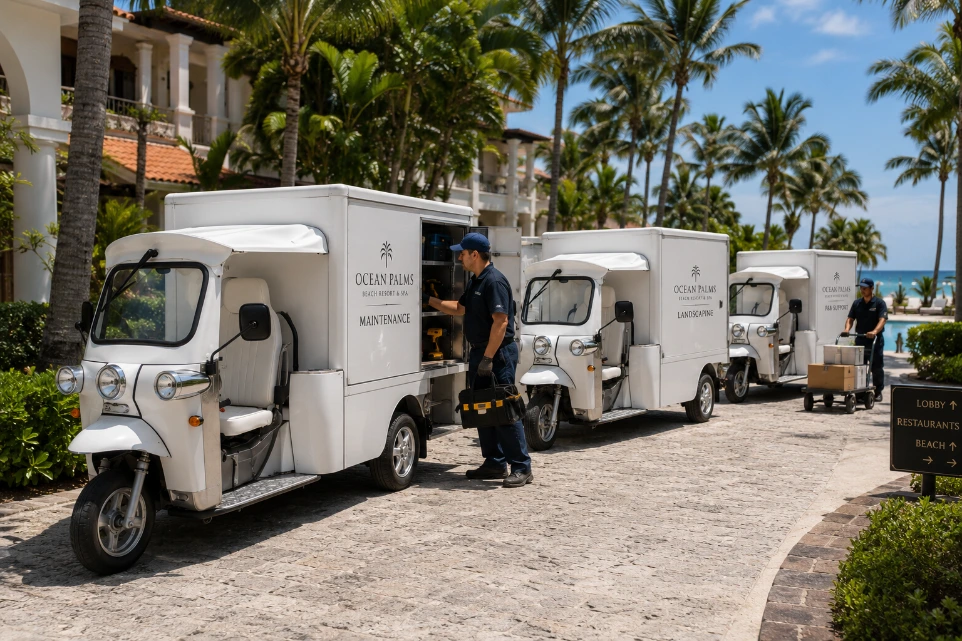
Move tools, parts, cleaning supplies and work-order materials around a defined property or service area.
Explore facilities applicationseTuk L5 Cargo utility platform
The eTuk L5 Cargo is a street-ready, VIN-assigned, 100% electric three-wheel utility vehicle with a configurable enclosed cargo body. It is built for facilities, campuses, hospitality properties, warehouses, field service and short-route logistics, with an MSRP of $24,999 for the standard cargo configuration.
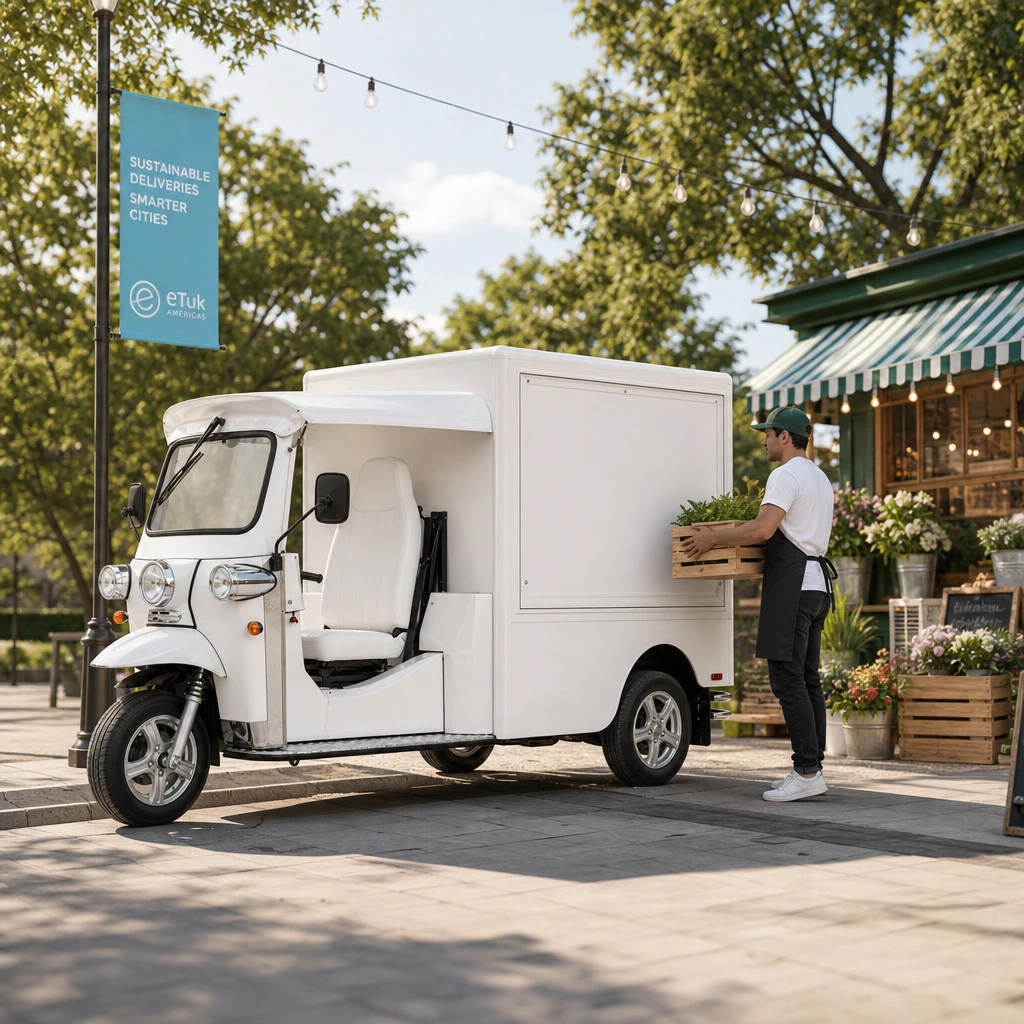
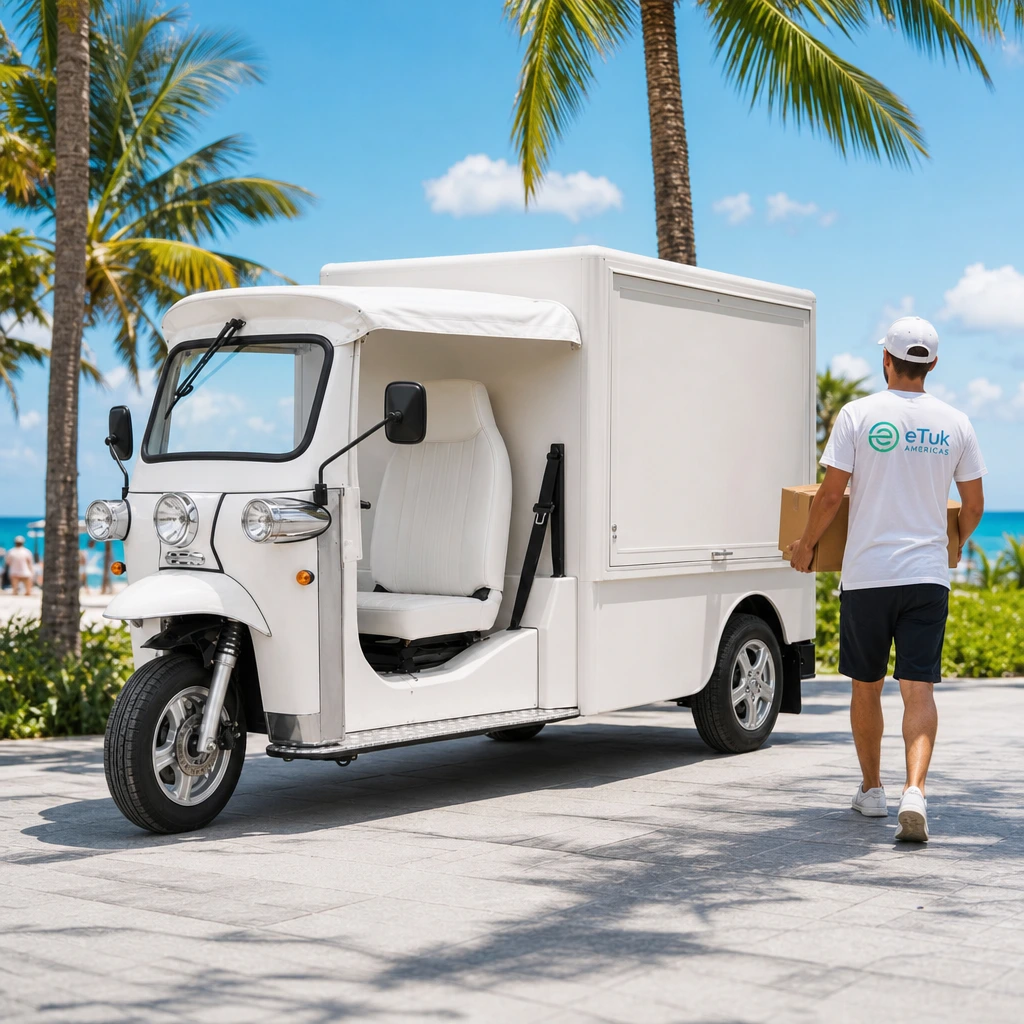
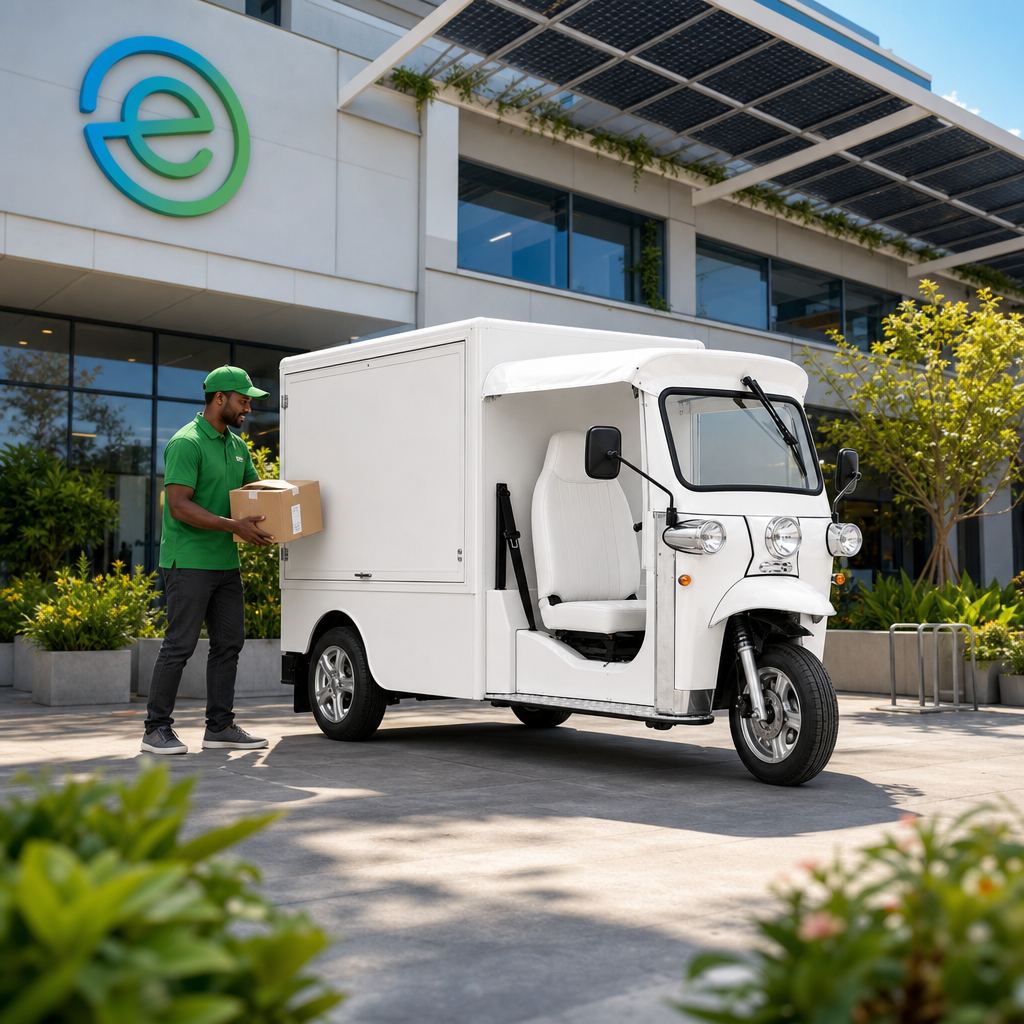
Application visualization; final vehicle body, access, branding and equipment vary by order. Street-ready does not mean one registration class or unrestricted road access nationwide. Confirm the exact operating mission and delivered specification.
The Cargo experience
A compact electric cargo fleet can support the daily rhythm of a resort, campus, facility or commercial property while presenting a clean, coordinated presence to guests and employees.
Image guidance: Vehicle photographs and visualizations show possible Cargo configurations. The signed proposal and vehicle-specific specification control the final body, doors, equipment, finish and branding.
Commercial applications
The L5 Cargo is strongest where a compact footprint, protected load space and configurable access improve a repeatable operating workflow.
Move tools, parts, cleaning supplies and work-order materials around a defined property or service area.
Explore facilities applicationsSupport mail, parcels, event materials, food service and short-route replenishment across campuses.
Explore campus operationsTransport supplies between buildings, yards, warehouses and controlled-access operating areas.
Explore warehouse useSupport housekeeping, engineering, amenities, events and back-of-property material movement.
Explore hospitality operationsConfigure secure storage, shelving, lighting and power around a technician or field-support workflow.
Explore custom outfittingStandardize bodies, parts, training, documentation, branding and support across a coordinated fleet.
Explore fleet planningClear product definitions
These platforms can share a vehicle foundation, but the operating intent, equipment and search intent are different.
This page focuses on moving and protecting tools, supplies, parcels, parts or equipment. The configuration begins with load, access, restraint, route and field workflow.
Current page: cargo platform →The vending page focuses on customer-facing sales or service, including counters, equipment, food or beverage workflow, auxiliary power, branding and permitting.
Explore vending platforms →Cargo-body reference
The standard enclosed body can remain open inside or receive project-specific storage and equipment. Door selection follows how, where and how often the operator needs to access the load.
Cargo access
Door locations, construction and hardware are confirmed during project review. Options are not included unless they appear in the signed specification.
The standard configuration includes rear access doors. Confirm opening size, hardware and loading clearance for your project.
A roll-up shutter can preserve clearance beside the vehicle and support frequent access where outward door swing is impractical.
An upward-opening hatch can provide wide access and overhead shelter for loading or field service, subject to final engineering.
Vehicle specification framework
The website provides planning facts. The vehicle-specific specification must align the route, load, body, energy, equipment and registration requirements.
| Platform | eTuk L5 Cargo street-ready electric three-wheel utility vehicle |
|---|---|
| VIN | An individual 17-character VIN is assigned to each vehicle. |
| Drivetrain | 100% electric, plug-in drivetrain |
| Standard body | Enclosed cargo box with rear access doors |
| Published payload reference | Manufacturer materials reference up to 800 kg / 1,764 lb for the platform. Final allowable payload is configuration-specific and must account for body, equipment, load distribution, center of gravity and applicable requirements. |
| Battery, range & charging | Configuration-specific. Confirm the current U.S. battery, charger, circuit, connector, charging time and route-based range estimate for the delivered vehicle. |
| Speed setup | Configuration- and regulation-specific. Confirm governed speed and permitted operating environment in the final specification. |
| Connectivity | Telematics, GPS and vehicle-intelligence functions may be available depending on hardware, subscription, coverage and final integration. |
| Registration category | State-specific. A three-wheel eTuk is not a federal four-wheel LSV. State terminology may include motorcycle, autocycle, moped, motor-driven cycle or another three-wheel category. |
Cargo eTuk price
Standard eTuk Cargo configuration; subject to change.
The standard configuration describes a white exterior, standard cargo box, rear access doors and white canopy. The final proposal must identify the exact vehicle, body, equipment and project costs.
Configuration directions
Every addition affects space, payload, energy demand, access, service and price. Final engineering and order documents control.
Define bins, drawers, tie-downs, restraint points, access zones and weight distribution around the actual cargo list.
Evaluate physical access control, alarm direction, camera placement and operating policy for the deployment environment.
Specify interior or task lighting and document every auxiliary electrical load before selecting a power architecture.
Scope location and vehicle-data functions around hardware, coverage, subscriptions, privacy policy and fleet needs.
Start with product temperature, hold time, ambient conditions, insulation, monitoring and energy demand before engineering.
Use exterior colors, identifiers, reflective treatments and graphics appropriate to the organization and operating environment.
Operational fit check
A cargo vehicle should be configured from a load list and duty cycle—not from appearance alone.
List item weights, dimensions, quantity, hazardous or temperature requirements, loading sequence and restraint needs.
Define rear or side access, door type, opening size, working clearance, loading height and frequency of access.
Document distance, hours, stops, grades, surfaces, weather, speed environment and charging windows.
Confirm registration, insurance, permitted roads, workplace rules, operator requirements and any load-specific regulation.
From mission to deployment
eTuk USA begins with the operating outcome, then confirms the body, equipment, price and support scope.
Share cargo, route, operating hours, environment, quantity and service outcome.
Select access, storage, restraint, security, power, connectivity and appearance.
Confirm payload, load placement, energy, documents, delivery and project price.
Coordinate delivery, operator guidance, parts planning and service pathways.
Deployment support
Support scope is confirmed in the proposal and may vary by project, quantity and configuration.
Vehicle operation, charging, daily inspection, safe loading and installed-equipment orientation.
Defined diagnostic, maintenance and escalation contacts appropriate to the deployment.
Replacement-parts pathway and an initial spare-parts recommendation for fleet projects.
Vehicle information, configuration record, operating guidance and support contacts.
Cargo electric tuk tuk FAQ
These answers distinguish the cargo platform, explain price and dimensions, and identify what requires a vehicle-specific review.
An electric cargo tuk tuk is a compact three-wheel commercial vehicle configured to move tools, supplies, parcels, parts or equipment. The eTuk L5 Cargo uses a street-ready, VIN-assigned electric platform with an enclosed body that can be configured around a defined load and workflow.
The eTuk L5 Cargo has an MSRP of $24,999 for a white vehicle with standard cargo box, rear access doors and white canopy. Custom equipment, delivery, taxes, title, registration, insurance, financing and compliance costs may be additional.
Yes. Each eTuk Cargo vehicle is delivered in a street-ready configuration and assigned an individual 17-character VIN. The responsible state or local authority still determines titling, registration, licensing, insurance and permitted roads.
Registration terminology varies by state and vehicle configuration. A state may use motorcycle, autocycle, moped, motor-driven-cycle or another category. A three-wheel eTuk should not be described as a federal LSV because the federal LSV definition applies to four-wheeled vehicles.
Manufacturer materials publish an up-to-800-kg platform reference, but that is not a universal allowance for every build. Final payload depends on the body, options, driver, load distribution, center of gravity and applicable requirements and must be confirmed for the delivered vehicle.
The May 23, 2024 draft drawing shows nominal cargo-body dimensions of 1,802 mm long, 1,352 mm wide and 1,445 mm high, with approximately 1,276 mm internal width and 1,340 mm internal height. The final production drawing controls.
The standard configuration includes rear access doors. Project options may include roll-up shutters or upward-opening hatches in approved positions. Door quantity, location, opening size and hardware must be listed in the signed specification.
Battery, range and charging depend on the selected power pack, load, route, speed, grades, weather, battery condition and electrical setup. Use the vehicle-specific U.S. specification and route review instead of a general brochure figure.
Cargo configurations prioritize protected movement of goods, tools and equipment. Vendo configurations prioritize customer-facing sales or service and may require counters, food or beverage equipment, auxiliary power, branding and additional permitting.
eTuk USA publishes platform information and price context. Specific vehicles currently available are maintained separately through Current Motors; the eTuk USA vehicle-and-price overview provides that handoff without acting as a shop.
Share the load, route, access method, operating hours and required equipment. eTuk USA will help define the body, configuration and next step.
eTuk L5 Cargo utility platform
The eTuk L5 Cargo is a street-ready, VIN-assigned, 100% electric three-wheel utility vehicle with a configurable enclosed cargo body. It is built for facilities, campuses, hospitality properties, warehouses, field service and short-route logistics, with an MSRP of $24,999 for the standard cargo configuration.
Application visualization; final vehicle body, access, branding and equipment vary by order. Street-ready does not mean one registration class or unrestricted road access nationwide. Confirm the exact operating mission and delivered specification.
The Cargo experience
A compact electric cargo fleet can support the daily rhythm of a resort, campus, facility or commercial property while presenting a clean, coordinated presence to guests and employees.
Image guidance: Vehicle photographs and visualizations show possible Cargo configurations. The signed proposal and vehicle-specific specification control the final body, doors, equipment, finish and branding.
Commercial applications
The L5 Cargo is strongest where a compact footprint, protected load space and configurable access improve a repeatable operating workflow.
Move tools, parts, cleaning supplies and work-order materials around a defined property or service area.
Explore facilities applicationsSupport mail, parcels, event materials, food service and short-route replenishment across campuses.
Explore campus operationsTransport supplies between buildings, yards, warehouses and controlled-access operating areas.
Explore warehouse useSupport housekeeping, engineering, amenities, events and back-of-property material movement.
Explore hospitality operationsConfigure secure storage, shelving, lighting and power around a technician or field-support workflow.
Explore custom outfittingStandardize bodies, parts, training, documentation, branding and support across a coordinated fleet.
Explore fleet planningClear product definitions
These platforms can share a vehicle foundation, but the operating intent, equipment and search intent are different.
This page focuses on moving and protecting tools, supplies, parcels, parts or equipment. The configuration begins with load, access, restraint, route and field workflow.
Current page: cargo platform →The vending page focuses on customer-facing sales or service, including counters, equipment, food or beverage workflow, auxiliary power, branding and permitting.
Explore vending platforms →Cargo-body reference
The standard enclosed body can remain open inside or receive project-specific storage and equipment. Door selection follows how, where and how often the operator needs to access the load.
Cargo access
Door locations, construction and hardware are confirmed during project review. Options are not included unless they appear in the signed specification.
The standard configuration includes rear access doors. Confirm opening size, hardware and loading clearance for your project.
A roll-up shutter can preserve clearance beside the vehicle and support frequent access where outward door swing is impractical.
An upward-opening hatch can provide wide access and overhead shelter for loading or field service, subject to final engineering.
Vehicle specification framework
The website provides planning facts. The vehicle-specific specification must align the route, load, body, energy, equipment and registration requirements.
| Platform | eTuk L5 Cargo street-ready electric three-wheel utility vehicle |
|---|---|
| VIN | An individual 17-character VIN is assigned to each vehicle. |
| Drivetrain | 100% electric, plug-in drivetrain |
| Standard body | Enclosed cargo box with rear access doors |
| Published payload reference | Manufacturer materials reference up to 800 kg / 1,764 lb for the platform. Final allowable payload is configuration-specific and must account for body, equipment, load distribution, center of gravity and applicable requirements. |
| Battery, range & charging | Configuration-specific. Confirm the current U.S. battery, charger, circuit, connector, charging time and route-based range estimate for the delivered vehicle. |
| Speed setup | Configuration- and regulation-specific. Confirm governed speed and permitted operating environment in the final specification. |
| Connectivity | Telematics, GPS and vehicle-intelligence functions may be available depending on hardware, subscription, coverage and final integration. |
| Registration category | State-specific. A three-wheel eTuk is not a federal four-wheel LSV. State terminology may include motorcycle, autocycle, moped, motor-driven cycle or another three-wheel category. |
Cargo eTuk price
Standard eTuk Cargo configuration; subject to change.
The standard configuration describes a white exterior, standard cargo box, rear access doors and white canopy. The final proposal must identify the exact vehicle, body, equipment and project costs.
Configuration directions
Every addition affects space, payload, energy demand, access, service and price. Final engineering and order documents control.
Define bins, drawers, tie-downs, restraint points, access zones and weight distribution around the actual cargo list.
Evaluate physical access control, alarm direction, camera placement and operating policy for the deployment environment.
Specify interior or task lighting and document every auxiliary electrical load before selecting a power architecture.
Scope location and vehicle-data functions around hardware, coverage, subscriptions, privacy policy and fleet needs.
Start with product temperature, hold time, ambient conditions, insulation, monitoring and energy demand before engineering.
Use exterior colors, identifiers, reflective treatments and graphics appropriate to the organization and operating environment.
Operational fit check
A cargo vehicle should be configured from a load list and duty cycle—not from appearance alone.
List item weights, dimensions, quantity, hazardous or temperature requirements, loading sequence and restraint needs.
Define rear or side access, door type, opening size, working clearance, loading height and frequency of access.
Document distance, hours, stops, grades, surfaces, weather, speed environment and charging windows.
Confirm registration, insurance, permitted roads, workplace rules, operator requirements and any load-specific regulation.
From mission to deployment
eTuk USA begins with the operating outcome, then confirms the body, equipment, price and support scope.
Share cargo, route, operating hours, environment, quantity and service outcome.
Select access, storage, restraint, security, power, connectivity and appearance.
Confirm payload, load placement, energy, documents, delivery and project price.
Coordinate delivery, operator guidance, parts planning and service pathways.
Deployment support
Support scope is confirmed in the proposal and may vary by project, quantity and configuration.
Vehicle operation, charging, daily inspection, safe loading and installed-equipment orientation.
Defined diagnostic, maintenance and escalation contacts appropriate to the deployment.
Replacement-parts pathway and an initial spare-parts recommendation for fleet projects.
Vehicle information, configuration record, operating guidance and support contacts.
Cargo electric tuk tuk FAQ
These answers distinguish the cargo platform, explain price and dimensions, and identify what requires a vehicle-specific review.
An electric cargo tuk tuk is a compact three-wheel commercial vehicle configured to move tools, supplies, parcels, parts or equipment. The eTuk L5 Cargo uses a street-ready, VIN-assigned electric platform with an enclosed body that can be configured around a defined load and workflow.
The eTuk L5 Cargo has an MSRP of $24,999 for a white vehicle with standard cargo box, rear access doors and white canopy. Custom equipment, delivery, taxes, title, registration, insurance, financing and compliance costs may be additional.
Yes. Each eTuk Cargo vehicle is delivered in a street-ready configuration and assigned an individual 17-character VIN. The responsible state or local authority still determines titling, registration, licensing, insurance and permitted roads.
Registration terminology varies by state and vehicle configuration. A state may use motorcycle, autocycle, moped, motor-driven-cycle or another category. A three-wheel eTuk should not be described as a federal LSV because the federal LSV definition applies to four-wheeled vehicles.
Manufacturer materials publish an up-to-800-kg platform reference, but that is not a universal allowance for every build. Final payload depends on the body, options, driver, load distribution, center of gravity and applicable requirements and must be confirmed for the delivered vehicle.
The May 23, 2024 draft drawing shows nominal cargo-body dimensions of 1,802 mm long, 1,352 mm wide and 1,445 mm high, with approximately 1,276 mm internal width and 1,340 mm internal height. The final production drawing controls.
The standard configuration includes rear access doors. Project options may include roll-up shutters or upward-opening hatches in approved positions. Door quantity, location, opening size and hardware must be listed in the signed specification.
Battery, range and charging depend on the selected power pack, load, route, speed, grades, weather, battery condition and electrical setup. Use the vehicle-specific U.S. specification and route review instead of a general brochure figure.
Cargo configurations prioritize protected movement of goods, tools and equipment. Vendo configurations prioritize customer-facing sales or service and may require counters, food or beverage equipment, auxiliary power, branding and additional permitting.
eTuk USA publishes platform information and price context. Specific vehicles currently available are maintained separately through Current Motors; the eTuk USA vehicle-and-price overview provides that handoff without acting as a shop.
Share the load, route, access method, operating hours and required equipment. eTuk USA will help define the body, configuration and next step.
We use cookies to provide you a better user experience on this website. Cookie Policy