Guest & Property Operations
Combine passenger transportation with cargo support or customer-facing mobile service across a resort or destination.
Explore hospitality →
Commercial fleet planning
A business buying an electric tuk tuk fleet should define the job, route, peak demand, payload, charging windows, registration, staffing and support plan before setting vehicle quantity. eTuk USA helps organizations compare Passenger, Cargo and Vendo platforms, develop a pilot or phased rollout, standardize approved configurations and request a written multi-vehicle proposal.
Fleet pricing, availability, configuration, production or delivery timing and support scope must be confirmed in writing. Do not assume a volume discount or deployment date from a public single-vehicle MSRP.
Fleet applications
The strongest deployments have repeatable work, known locations, measurable demand and a practical charging and support pathway.
Combine passenger transportation with cargo support or customer-facing mobile service across a resort or destination.
Explore hospitality →Support passenger circulation, facilities work, deliveries and mobile food or beverage service across defined sites.
Explore industries →Coordinate guest movement, operational cargo and branded service units around repeatable event requirements.
Discuss event fleets →Deploy a documented vehicle and equipment standard across multiple properties, routes or business units.
Discuss multiple sites →Build the fleet by job
Standardization does not mean every vehicle must have the same body. It means each approved configuration has a defined purpose, specification and support pathway.

For guest transportation, campus circulation, parking connections, events, tours and defined short-distance routes.
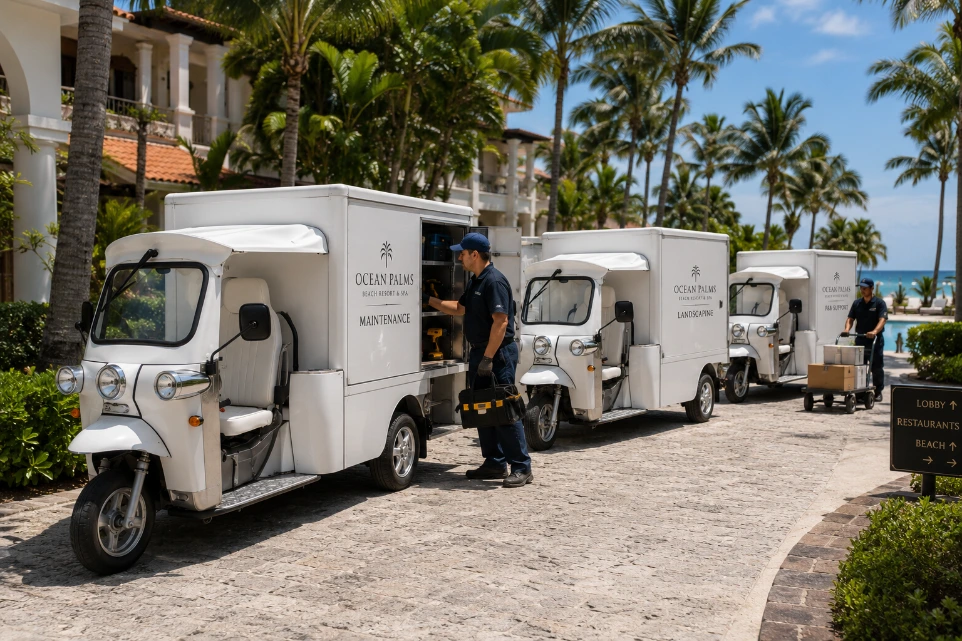
For facilities, maintenance, supplies, equipment, goods and operational movement in an enclosed body.

For mobile coffee, ice cream, beverages, food service, retail, hospitality and branded activations.
Fleet sizing
There is no responsible universal fleet-size answer. Quantity must follow demand, trip cycle, workload, charging, operating hours and continuity requirements.
Capacity per cycle must be demonstrated for the actual route or workflow. Any spare or continuity allowance should be justified by service targets and operating risk—not copied from an unrelated fleet.
Passengers, trips, loads, service transactions or tasks by hour, shift and day.
Travel, loading, unloading, dwell, cleaning, restocking and return time.
Daily energy need, parking, circuits, rotation, charging time and reserve.
Shifts, peak periods, seasonal demand, events and multi-site movement.
Acceptable wait, backlog or downtime and the response when a vehicle is unavailable.
Documented demand, utilization or service threshold that justifies another vehicle.
Pilot before scale
A pilot is useful when route, demand, equipment, charging or workflow has not yet been demonstrated in the intended environment.
State what the vehicle must accomplish and which measurable result will support expansion.
Use the intended route, load, weather, staffing, charging and customer or passenger workflow.
Track cycles, demand, charging, downtime, operator feedback and maintenance observations.
Approve the configuration, correct the plan or stop before committing to a wider deployment.

Charging and site readiness
Confirm where each vehicle parks, when it is available to charge, which circuit and charger apply, how charging is sequenced and who is responsible. Route, load, temperature, accessory demand and operating pattern affect daily energy use.
Fleet procurement brief
A complete proposal reduces ambiguity across procurement, operations, finance, facilities and service teams.
| Area | Required definition | Buyer review |
|---|---|---|
| Vehicles | Quantity by platform and approved configuration. | Passenger, Cargo or Vendo purpose; body, seating, equipment, finish and identification. |
| Price | Written fleet price and itemized included scope. | Do not assume public MSRP, a discount or an all-inclusive total. Confirm every inclusion and exclusion. |
| Availability & timing | Configuration status, schedule assumptions and delivery destination. | Confirm milestones, buyer dependencies and how changes affect timing. |
| Documentation | Documents supplied with the vehicles and responsibilities for title or registration. | Confirm state classification, licensing, insurance and permitted-road requirements. |
| Charging | Vehicle charger and any included charging equipment. | Verify circuits, site work, parking, charging windows, energy reserve and responsibility. |
| Orientation | Operator and ownership resources included in the agreed scope. | Define audiences, location, materials, attendance and internal procedure ownership. |
| Service & parts | Applicable maintenance, diagnostic, escalation and parts pathways. | Define responsibility, location, lead-time assumptions and fleet spare-parts strategy. |
| Acceptance | Delivery inspection, documentation review and issue-reporting process. | Name authorized contacts and establish the acceptance record for each vehicle. |
Fleet price and financing
Public MSRP is a single-vehicle reference for an identified configuration. A fleet proposal must confirm quantity, vehicle mix, options, delivery and support scope. Do not assume a volume discount; any fleet pricing must appear in the written proposal.
Quantity and approved Passenger, Cargo or Vendo configuration for each role.
Charging, electrical work, parking, receiving and operating-area preparation.
Destination logistics, taxes, title, registration, insurance and administrative work.
Staffing, training, inventory, permits, service, parts and downtime planning.
Fleet ownership pathway
The final fleet proposal should identify which resources and responsibilities apply to the selected vehicles and deployment.
Maintain an approved specification by role, site or deployment phase.
Standardize inspections, charging, driving, loading and passenger or service procedures.
Define inspection, preventive service, diagnostics, escalation and recordkeeping.
Identify replacement-parts access and a justified fleet spare-parts strategy.
Document how work continues when a vehicle, charger or route is unavailable.
Track utilization, demand, energy, issues and expansion triggers against the plan.
Use a repeatable discovery and approval process before copying a configuration elsewhere.
Keep vehicle, operator, service, incident and configuration records by VIN.
From discovery to fleet operation
Each phase should have an owner, decision criteria and written output.
Define sites, jobs, demand, routes, loads, charging and stakeholders.
Estimate vehicle mix and quantity from operating cycles and service targets.
Validate the vehicle, workflow, charging and documentation where needed.
Approve configurations, procedures, training and support responsibilities.
Review written quantity, price, timing, delivery, exclusions and acceptance.
Launch, record performance, resolve issues and expand from evidence.
Electric tuk tuk fleet FAQ
These answers focus on quantity, pilot, price, charging, deployment and ownership.
Define each vehicle's job, route or service area, peak demand, load, operating cycle, charging windows, staffing, registration, insurance and support requirements. Use those facts to choose Passenger, Cargo or Vendo configurations and estimate quantity.
Quantity depends on required work, validated capacity per operating cycle, charging availability, operating hours and continuity targets. Do not use a universal ratio. Model the actual route or workflow and justify any spare capacity.
A pilot or phased rollout is useful when route, demand, equipment, charging, workflow or registration assumptions have not been demonstrated in the intended environment. Define success criteria, test real conditions and use the results before wider deployment.
Yes. A mixed fleet can assign Passenger to mobility, Cargo to operational work and Vendo to customer-facing service. Each role should have an approved specification, operating procedure, charging plan and support pathway.
Fleet cost depends on quantity, vehicle mix, approved configurations, options, delivery and deployment scope. Passenger has a $27,999 single-vehicle MSRP reference and standard Cargo has a $24,999 single-vehicle MSRP reference, both subject to change; Vendo requires a custom quote. The written fleet proposal controls.
Do not assume a discount from public MSRP or quantity alone. Any fleet pricing, commercial terms or included services must be evaluated for the specific project and stated in the written proposal.
Map daily energy demand, parking, electrical capacity, charger requirements, charging windows, vehicle rotation and operating reserve. Assign responsibility for inspections and charging, and create a response plan for interruptions.
Delivered eTuk vehicles are configured as street-ready and assigned individual VINs when stated in the final specifications. State and local authorities still determine title, registration class, licensing, insurance and permitted roads for each vehicle and operation.
Financing may be available subject to provider terms, applicant approval, vehicle mix and project structure. Obtain a written fleet proposal and confirm which vehicles, equipment, delivery and other costs may be financed.
Provide organization, sites, intended uses, vehicle roles, route or service area, demand, load, operating hours, charging plan, required equipment, delivery destinations, target pilot or launch timing, budget range and decision process.
Tell us the sites, vehicle roles, routes, demand, operating hours, charging plan and target timing. eTuk USA will help organize the platform comparison and written fleet-planning next step.
Commercial fleet planning
A business buying an electric tuk tuk fleet should define the job, route, peak demand, payload, charging windows, registration, staffing and support plan before setting vehicle quantity. eTuk USA helps organizations compare Passenger, Cargo and Vendo platforms, develop a pilot or phased rollout, standardize approved configurations and request a written multi-vehicle proposal.
Fleet pricing, availability, configuration, production or delivery timing and support scope must be confirmed in writing. Do not assume a volume discount or deployment date from a public single-vehicle MSRP.
Fleet applications
The strongest deployments have repeatable work, known locations, measurable demand and a practical charging and support pathway.
Combine passenger transportation with cargo support or customer-facing mobile service across a resort or destination.
Explore hospitality →Support passenger circulation, facilities work, deliveries and mobile food or beverage service across defined sites.
Explore industries →Coordinate guest movement, operational cargo and branded service units around repeatable event requirements.
Discuss event fleets →Deploy a documented vehicle and equipment standard across multiple properties, routes or business units.
Discuss multiple sites →Build the fleet by job
Standardization does not mean every vehicle must have the same body. It means each approved configuration has a defined purpose, specification and support pathway.
For guest transportation, campus circulation, parking connections, events, tours and defined short-distance routes.
For facilities, maintenance, supplies, equipment, goods and operational movement in an enclosed body.
For mobile coffee, ice cream, beverages, food service, retail, hospitality and branded activations.
Fleet sizing
There is no responsible universal fleet-size answer. Quantity must follow demand, trip cycle, workload, charging, operating hours and continuity requirements.
Capacity per cycle must be demonstrated for the actual route or workflow. Any spare or continuity allowance should be justified by service targets and operating risk—not copied from an unrelated fleet.
Passengers, trips, loads, service transactions or tasks by hour, shift and day.
Travel, loading, unloading, dwell, cleaning, restocking and return time.
Daily energy need, parking, circuits, rotation, charging time and reserve.
Shifts, peak periods, seasonal demand, events and multi-site movement.
Acceptable wait, backlog or downtime and the response when a vehicle is unavailable.
Documented demand, utilization or service threshold that justifies another vehicle.
Pilot before scale
A pilot is useful when route, demand, equipment, charging or workflow has not yet been demonstrated in the intended environment.
State what the vehicle must accomplish and which measurable result will support expansion.
Use the intended route, load, weather, staffing, charging and customer or passenger workflow.
Track cycles, demand, charging, downtime, operator feedback and maintenance observations.
Approve the configuration, correct the plan or stop before committing to a wider deployment.
Charging and site readiness
Confirm where each vehicle parks, when it is available to charge, which circuit and charger apply, how charging is sequenced and who is responsible. Route, load, temperature, accessory demand and operating pattern affect daily energy use.
Fleet procurement brief
A complete proposal reduces ambiguity across procurement, operations, finance, facilities and service teams.
| Area | Required definition | Buyer review |
|---|---|---|
| Vehicles | Quantity by platform and approved configuration. | Passenger, Cargo or Vendo purpose; body, seating, equipment, finish and identification. |
| Price | Written fleet price and itemized included scope. | Do not assume public MSRP, a discount or an all-inclusive total. Confirm every inclusion and exclusion. |
| Availability & timing | Configuration status, schedule assumptions and delivery destination. | Confirm milestones, buyer dependencies and how changes affect timing. |
| Documentation | Documents supplied with the vehicles and responsibilities for title or registration. | Confirm state classification, licensing, insurance and permitted-road requirements. |
| Charging | Vehicle charger and any included charging equipment. | Verify circuits, site work, parking, charging windows, energy reserve and responsibility. |
| Orientation | Operator and ownership resources included in the agreed scope. | Define audiences, location, materials, attendance and internal procedure ownership. |
| Service & parts | Applicable maintenance, diagnostic, escalation and parts pathways. | Define responsibility, location, lead-time assumptions and fleet spare-parts strategy. |
| Acceptance | Delivery inspection, documentation review and issue-reporting process. | Name authorized contacts and establish the acceptance record for each vehicle. |
Fleet price and financing
Public MSRP is a single-vehicle reference for an identified configuration. A fleet proposal must confirm quantity, vehicle mix, options, delivery and support scope. Do not assume a volume discount; any fleet pricing must appear in the written proposal.
Quantity and approved Passenger, Cargo or Vendo configuration for each role.
Charging, electrical work, parking, receiving and operating-area preparation.
Destination logistics, taxes, title, registration, insurance and administrative work.
Staffing, training, inventory, permits, service, parts and downtime planning.
Fleet ownership pathway
The final fleet proposal should identify which resources and responsibilities apply to the selected vehicles and deployment.
Maintain an approved specification by role, site or deployment phase.
Standardize inspections, charging, driving, loading and passenger or service procedures.
Define inspection, preventive service, diagnostics, escalation and recordkeeping.
Identify replacement-parts access and a justified fleet spare-parts strategy.
Document how work continues when a vehicle, charger or route is unavailable.
Track utilization, demand, energy, issues and expansion triggers against the plan.
Use a repeatable discovery and approval process before copying a configuration elsewhere.
Keep vehicle, operator, service, incident and configuration records by VIN.
From discovery to fleet operation
Each phase should have an owner, decision criteria and written output.
Define sites, jobs, demand, routes, loads, charging and stakeholders.
Estimate vehicle mix and quantity from operating cycles and service targets.
Validate the vehicle, workflow, charging and documentation where needed.
Approve configurations, procedures, training and support responsibilities.
Review written quantity, price, timing, delivery, exclusions and acceptance.
Launch, record performance, resolve issues and expand from evidence.
Electric tuk tuk fleet FAQ
These answers focus on quantity, pilot, price, charging, deployment and ownership.
Define each vehicle's job, route or service area, peak demand, load, operating cycle, charging windows, staffing, registration, insurance and support requirements. Use those facts to choose Passenger, Cargo or Vendo configurations and estimate quantity.
Quantity depends on required work, validated capacity per operating cycle, charging availability, operating hours and continuity targets. Do not use a universal ratio. Model the actual route or workflow and justify any spare capacity.
A pilot or phased rollout is useful when route, demand, equipment, charging, workflow or registration assumptions have not been demonstrated in the intended environment. Define success criteria, test real conditions and use the results before wider deployment.
Yes. A mixed fleet can assign Passenger to mobility, Cargo to operational work and Vendo to customer-facing service. Each role should have an approved specification, operating procedure, charging plan and support pathway.
Fleet cost depends on quantity, vehicle mix, approved configurations, options, delivery and deployment scope. Passenger has a $27,999 single-vehicle MSRP reference and standard Cargo has a $24,999 single-vehicle MSRP reference, both subject to change; Vendo requires a custom quote. The written fleet proposal controls.
Do not assume a discount from public MSRP or quantity alone. Any fleet pricing, commercial terms or included services must be evaluated for the specific project and stated in the written proposal.
Map daily energy demand, parking, electrical capacity, charger requirements, charging windows, vehicle rotation and operating reserve. Assign responsibility for inspections and charging, and create a response plan for interruptions.
Delivered eTuk vehicles are configured as street-ready and assigned individual VINs when stated in the final specifications. State and local authorities still determine title, registration class, licensing, insurance and permitted roads for each vehicle and operation.
Financing may be available subject to provider terms, applicant approval, vehicle mix and project structure. Obtain a written fleet proposal and confirm which vehicles, equipment, delivery and other costs may be financed.
Provide organization, sites, intended uses, vehicle roles, route or service area, demand, load, operating hours, charging plan, required equipment, delivery destinations, target pilot or launch timing, budget range and decision process.
Tell us the sites, vehicle roles, routes, demand, operating hours, charging plan and target timing. eTuk USA will help organize the platform comparison and written fleet-planning next step.