Skip to Content
Electric eTuk passenger vehicle illustrating overnight electric vehicle charging

Simple everyday electric vehicle charging

How to Charge an Electric Tuk Tuk

Charging an eTuk is straightforward: plug the supplied charger into a standard 110V outlet and allow approximately 8–12 hours for a typical full charging cycle. For most owners and operators, that means plugging the vehicle in at the end of the day and having it ready for the next operating period.

Standard 110V outlet Charger included with vehicle Typical 8–12 hour charge Fleet and auxiliary power options

Cargo and Vendo builds may also be configured with additional electrical systems depending on the application. Confirm any auxiliary power or separate-circuit requirements in the written vehicle build specification.

Direct answer

What do I need to charge an eTuk?

You need the charger supplied with the eTuk and access to a standard 110V electrical outlet. Connect the vehicle after use and plan approximately 8–12 hours when a full charging cycle is required.

  1. Park the eTuk at its normal charging location.
  2. Connect the supplied charging equipment.
  3. Plug into an appropriate standard 110V outlet.
  4. Allow approximately 8–12 hours for a typical full charge.
  5. Disconnect and return the vehicle to service.

Outlet

Standard 110V

No dedicated public EV fast-charging station is required for normal charging.

Equipment

Charger Included

The vehicle is supplied with its charging equipment.

Timing

8–12 Hours

Overnight charging fits naturally into many operating routines.

Planning

Charge During Downtime

Build charging around the hours when the eTuk is not needed.

Daily charging routine

Plug in after the operating day. Start again the next day.

For many owners, charging can become as routine as parking the vehicle at the end of a shift.

01 / PARK

Return to Base

Park at the assigned location at the end of the operating period.

02 / CONNECT

Plug In

Connect the supplied charger and standard 110V power source.

03 / CHARGE

Use the Downtime

Allow approximately 8–12 hours for a typical full charging cycle.

04 / GO

Return to Service

Disconnect the charger before beginning the next operating period.

Electric eTuks staged between operating periods
Because normal eTuk charging uses standard 110V power, charging can often be incorporated into existing overnight parking or fleet staging.

Home, business or fleet base

You do not need a public EV charging station to own an eTuk.

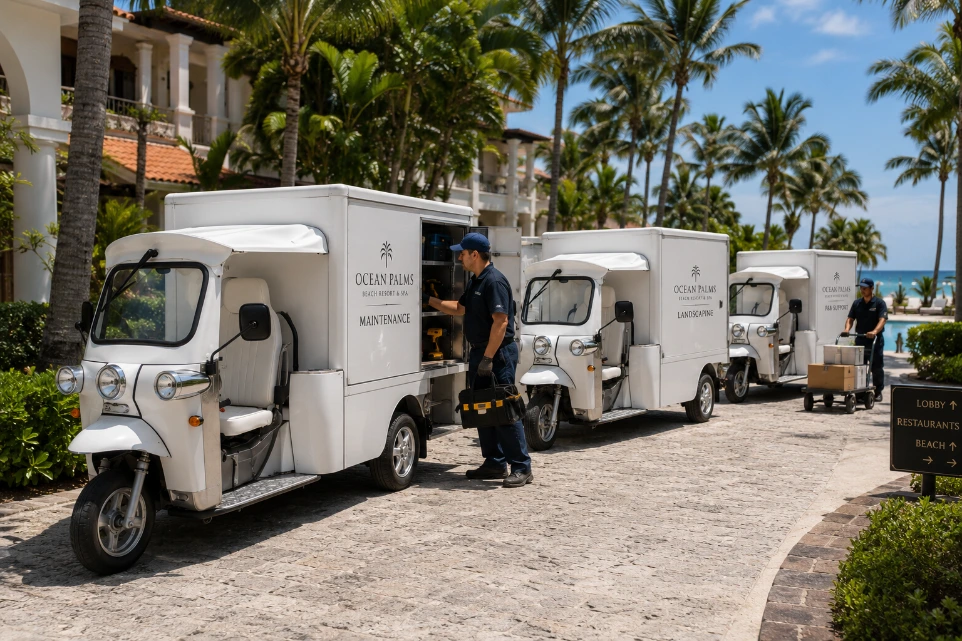
Normal eTuk charging can use a standard 110V outlet. That makes the vehicle practical for private owners as well as hotels, resorts, universities, municipalities and businesses with a normal overnight parking location.

The important planning question is usually not “Where is the nearest EV charger?” but rather “Where will the eTuk be parked for 8–12 hours when it is not being used?”

  • Choose a consistent overnight parking location
  • Provide access to standard 110V power
  • Keep the charging cable clear of vehicle and pedestrian traffic
  • Assign charging responsibility for shared vehicles
  • Coordinate charging with operating schedules
  • For fleets, plan enough charging positions for vehicle quantity

Cargo & Vendo electrical planning

Commercial builds can go beyond basic vehicle charging.

Cargo and Vendo projects can be designed around additional electrical requirements when the business or equipment calls for it.

Electric Cargo and Vendo eTuk illustrating auxiliary power and commercial electrical applications

Auxiliary Power Unit options

For appropriate Cargo or Vendo builds, an auxiliary power solution can be evaluated as part of the project. That can provide additional energy flexibility without treating the commercial equipment and propulsion system as one undifferentiated electrical load.

BACKUP ENERGY

Additional Power Source

A project can be evaluated with an auxiliary power unit or additional portable energy source for appropriate backup or operational support.

SEPARATE CIRCUIT

Keep the Box Independent

Vendo equipment or a commercial box can be designed around a separate electrical circuit when the application requires it.

BUSINESS EQUIPMENT

Build Around the Load

Coffee, refrigeration, service equipment, POS or other commercial systems should be scoped independently from normal vehicle charging.

Charging by application

The 8–12 hour window is easiest to manage when charging follows the workday.

Different applications use the same basic charging principle but may have very different schedules.

PRIVATE OWNER

Charge at Home

Park the eTuk where it has access to standard 110V power and use overnight downtime for charging.

HOTELS & RESORTS

Charge Between Service Days

Tie charging to guest-service schedules and the property's overnight vehicle parking.

CAMPUSES

Return Vehicles to Base

Assign charging positions by department and expected daily utilization.

MUNICIPAL

Central Fleet Charging

Combine vehicle storage, overnight charging and fleet ownership.

CARGO

Charge Around Work Shifts

Facilities and operational vehicles can recharge during predictable off-hours.

VENDO

Separate Vehicle and Business Energy

Plan propulsion charging separately from refrigeration, appliances or other business equipment when needed.

Fleet charging

One 110V outlet may be simple. A fleet needs a charging plan.

Vehicle quantity, outlet availability, operating windows and charging positions should be designed together.

QUANTITY

How Many Vehicles?

Determine how many vehicles may need charging at the same time.

WINDOW

How Long Are They Parked?

The typical 8–12 hour charging window works naturally with overnight storage.

POWER

How Many Charging Positions?

Plan sufficient electrical access for expected fleet utilization.

OWNERSHIP

Who Is Responsible?

Assign responsibility for parking, connecting and checking fleet vehicles.

Charging is part of ownership

A normal 110V outlet makes the ownership plan simple.

Whether you are buying one vehicle for personal use or building a commercial fleet, include the overnight parking and charging location in the plan. For Cargo and Vendo projects, tell eTuk USA about any additional electrical loads so the build can be scoped correctly.

Charging good practice

Simple charging still deserves a consistent routine.

Keep the electrical source, charger, cable and parking area suitable for normal use.

OUTLET

Use Suitable 110V Power

Use an appropriate electrical source in the planned charging location.

CHARGER

Use the Supplied Equipment

Use the charger supplied or otherwise approved for the exact vehicle.

CABLE

Protect the Connection

Keep charging cables away from unnecessary vehicle and pedestrian traffic.

COMMERCIAL BUILD

Document Auxiliary Power

Cargo and Vendo auxiliary electrical systems should be defined in the project scope.

eTuk Charging FAQ

Straight answers to the most common charging questions.

Charging is one of the simpler parts of owning an eTuk.

What kind of outlet do I need to charge an eTuk?

A standard 110V outlet is sufficient for normal eTuk charging.

Is the charger included with the eTuk?

Yes. The charging equipment required for normal vehicle charging is supplied with the eTuk.

How long does an eTuk take to charge?

A typical full charging cycle takes approximately 8–12 hours, making overnight charging practical for many owners and operators.

Do I need a commercial EV charging station?

No. Normal eTuk charging can use a standard 110V electrical outlet.

Can I charge an eTuk overnight?

Yes. Overnight charging is a natural operating pattern because a typical full charge takes approximately 8–12 hours.

Can I charge an eTuk at home?

Yes, provided the parking location has suitable standard 110V electrical access for the supplied charger.

How should a hotel or resort charge eTuks?

A hotel or resort can assign overnight parking positions with 110V electrical access and charge the vehicles during normal downtime between guest-service periods.

How do fleets charge multiple eTuks?

Fleet operators should plan the number of charging positions around vehicle quantity, operating schedules and the typical 8–12 hour full charging window.

Can a Cargo eTuk have auxiliary power?

Yes. Appropriate Cargo projects can be evaluated with an auxiliary power unit or additional electrical system depending on the required operation.

Can a Vendo eTuk run its equipment on a separate circuit?

Yes. A Vendo build can be planned so the commercial box or equipment uses a separate circuit when the application requires it. The final electrical configuration should be defined as part of the custom build.

Can auxiliary power help if additional energy is needed?

Cargo and Vendo applications can be evaluated with auxiliary power solutions, including additional energy storage or an independent power source, according to the project requirements.

Does charging affect eTuk total cost of ownership?

Yes. Electricity is one component of vehicle operating cost and should be included alongside acquisition, financing, maintenance and utilization when evaluating total cost of ownership.

Plug it into 110V at the end of the day. Put it back to work tomorrow.

A standard 110V outlet, the supplied charger and an 8–12 hour typical full charging window make eTuk charging straightforward for private owners, businesses and fleet operators.