
Skip to Content
Electric eTuk fleet illustrating long-term vehicle ownership and operating planning

Purchase price is only the beginning

Electric Tuk Tuk Total Cost of Ownership

Total cost of ownership looks beyond the initial purchase price and considers the costs and value factors that develop throughout the ownership period: acquisition, financing, charging, maintenance, operating routines, downtime, utilization and eventual vehicle disposition.

Acquisition planning Operating-cost framework Fleet and individual buyers No invented savings assumptions

Actual ownership costs vary by vehicle configuration, financing terms, electricity rates, utilization, operating environment, maintenance requirements, insurance and other buyer-specific factors.

Direct answer

What is the total cost of owning an electric tuk tuk?

Total cost of ownership is the complete economic picture of the vehicle over the period you expect to own and operate it. It starts with acquisition cost, then adds financing, energy, maintenance, operating and downtime costs while accounting for utilization and any reasonable end-of-ownership value.

  1. Start with the complete delivered vehicle cost.
  2. Add financing and ownership-related expenses where applicable.
  3. Estimate charging and recurring operating costs.
  4. Plan preventive maintenance and potential downtime.
  5. Evaluate cost against actual vehicle utilization.
Upfront

Acquisition Cost

Include the actual vehicle, equipment and project scope.

Recurring

Operating Cost

Evaluate energy and other recurring ownership expenses.

Availability

Maintenance

Plan inspections, service and operational downtime.

Utilization

Cost per Useful Hour

A vehicle creates more value when it performs the intended work.

Build the complete cost picture

Six categories belong in an eTuk ownership model.

The exact numbers are buyer-specific, but the categories should remain consistent.

01 / VEHICLE

Acquisition

Vehicle price, selected configuration, optional equipment and other included build items.

02 / CAPITAL

Financing

Include applicable financing costs when comparing purchase structures.

03 / ENERGY

Charging

Estimate electricity from the actual charging location and operating routine.

04 / CARE

Maintenance

Plan preventive inspection, wear items and required service.

05 / OPERATIONS

Daily Use

Consider labor, insurance, storage and other application-specific expenses.

06 / LIFECYCLE

Ownership Period

Evaluate how long the vehicle is expected to remain in service and how heavily it will be used.

Electric Cargo eTuk illustrating daily commercial vehicle utilization
Ownership economics should be evaluated against the work the vehicle is expected to perform.

Utilization changes the equation

A vehicle that sits and a vehicle that works do not have the same economics.

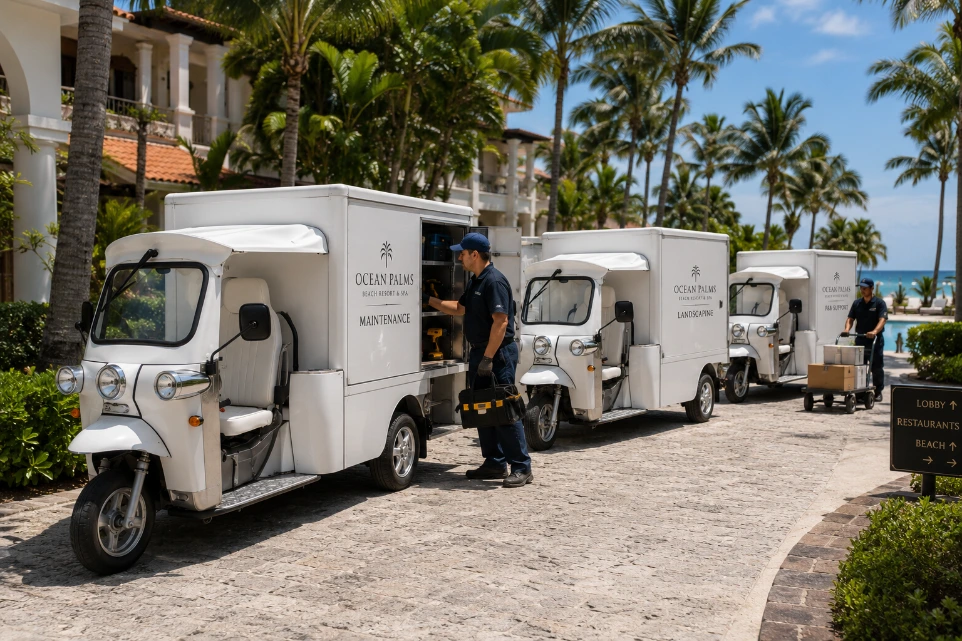
Total ownership cost becomes more useful when it is connected to utilization. A Cargo eTuk supporting recurring facilities work, for example, should be evaluated against the actual tasks and operating hours it can support.

Passenger fleets should be evaluated against routes, service windows and riders. Mobile-business vehicles should be evaluated against the actual business operation rather than against purchase price alone.

  • Operating days per year
  • Hours or service windows per day
  • Passenger movements or operational tasks
  • Seasonal changes in utilization
  • Charging windows and storage
  • Expected downtime for maintenance
  • Fleet backup requirements
  • Expected ownership period

A practical calculation framework

Use one consistent formula when comparing ownership options.

Do not insert generic savings percentages. Use the buyer's real inputs.

TCO = Acquisition + Financing + Energy + Maintenance + Operating CostsEnd-of-Cycle Value
ACQUISITION

Use the complete vehicle and project price rather than a partial base figure.

RECURRING COSTS

Use local energy and actual operating assumptions.

MAINTENANCE

Build service and downtime planning into the model.

RESIDUAL VALUE

Use a documented assumption rather than an unsupported resale promise.

Price versus ownership economics

Purchase price and total cost of ownership answer different questions.

Both matter. They simply describe different parts of the buying decision.

PURCHASE PRICE

What does the vehicle cost to acquire?

Use purchase pricing when evaluating initial budget and vehicle configuration.

  • Vehicle platform
  • Configuration
  • Optional equipment
  • Customization
  • Delivery scope
TOTAL COST OF OWNERSHIP

What does the vehicle cost over time?

Use TCO when comparing the economic impact of owning and operating the vehicle.

  • Acquisition
  • Financing
  • Energy
  • Maintenance
  • Operating costs
  • Utilization and lifecycle assumptions

Evaluate cost in context

The same eTuk can have very different economics in different applications.

Build the model around the actual operational purpose of the vehicle.

PASSENGER

Mobility

Evaluate routes, riders, schedules and service coverage.

CARGO

Operations

Evaluate tasks, loads, workflows and daily utilization.

VENDING

Business

Separate vehicle ownership cost from broader business economics.

FLEET

Multiple Vehicles

Add fleet coverage, quantity, shared infrastructure and deployment planning.

Build your ownership case

Start with real vehicle pricing and real operating assumptions.

Review the appropriate model, current inventory, project pricing and financing options before completing a total-cost model. For fleet buyers, define quantity and configuration before comparing lifecycle economics.

Ownership analysis pathway

Build your TCO model in four steps.

Use documented inputs and update the model when assumptions change.

  1. STEP 01

    Define Use

    Choose the application, vehicle and expected utilization.

  2. STEP 02

    Price Acquisition

    Build the complete purchase and financing picture.

  3. STEP 03

    Estimate Operation

    Add energy, maintenance, insurance and operating assumptions.

  4. STEP 04

    Compare Lifecycle

    Evaluate cost over the planned ownership and utilization period.

Responsible financial modeling

A useful TCO model makes its assumptions visible.

Avoid presenting estimated savings as guaranteed vehicle economics.

ENERGY

Use Local Rates

Electricity costs depend on the actual charging location and tariff.

MAINTENANCE

Use the Actual Vehicle

Service requirements depend on configuration, use and operating conditions.

UTILIZATION

Use Real Work

Model the vehicle around expected routes, hours or commercial activity.

LIFECYCLE

Document Assumptions

Ownership period and residual-value assumptions should be explicit.

Total Cost of Ownership FAQ

Questions buyers should answer before comparing lifecycle cost.

A strong TCO calculation uses documented assumptions rather than generic savings claims.

What does electric tuk tuk total cost of ownership include?

A TCO model can include acquisition, financing, charging, maintenance, operating costs, downtime and lifecycle assumptions over the expected ownership period.

Is total cost of ownership the same as purchase price?

No. Purchase price describes the initial acquisition. Total cost of ownership looks at the broader ownership period.

How should charging cost be estimated?

Use the charging routine and electricity rate applicable to the actual operating location.

Should maintenance be included in a TCO calculation?

Yes. Preventive maintenance, inspection, wear items, service and potential downtime should be considered when relevant.

Does utilization affect total cost of ownership?

Utilization gives cost context. A buyer should evaluate ownership cost against the routes, operating hours, tasks or commercial activity the vehicle is intended to support.

Should financing be included?

When financing is used, applicable financing costs should be included in the ownership model.

Can I use this framework for a fleet?

Yes. Fleet analysis should additionally consider vehicle quantity, configuration mix, shared infrastructure, required coverage and deployment timing.

Does eTuk USA guarantee a resale value?

This page does not make a guaranteed residual or resale-value claim. Any end-of-cycle value used in a financial model should be treated as a documented assumption.

Where should I start if I am considering an eTuk?

Start by selecting the appropriate model, reviewing current inventory and pricing, then build the ownership analysis around your actual application.

Start with the right vehicle, then model the complete ownership period.

Define the application, configuration, expected utilization, ownership period and operating environment. Then use real pricing and buyer-specific assumptions to evaluate total cost.